Katana Alternatives for US Small Businesses in 2026

The best Katana alternative depends on why you are leaving. If you need deeper shop-floor scheduling or full ERP accounting, look at MRPeasy, Odoo or Unleashed. If you want one affordable platform where you build your own inventory, CRM, contract and reporting apps without code, SoftEXIT Studio fits. Apps are included with a SoftEXIT Studio membership starting at $5/user/month, billed annually.
This guide covers the Katana MRP software used by product businesses, not the guitar amp. It lists the options US teams compare most, what they cost, and how to choose.
Key Takeaways
- Katana is a focused inventory and manufacturing tool. Teams usually look elsewhere when add-ons, usage-based fees or reporting limits start to bite.
- Unleashed, Ordoro, MRPeasy, Fishbowl and Odoo are the names that come up most often, and their pricing models differ widely.
- If your real pain is spreadsheets, scattered tools and per-app subscriptions, a no-code platform may fit better than another specialist system.
- SoftEXIT Studio includes CRM and Contract Management in one membership starting at $5/user/month, billed annually, and lets you build custom apps on the same platform.
What Katana does and why teams look elsewhere
Katana is a cloud-based MRP system for small to midsize product businesses. According to SoftwareConnect’s review, it covers inventory, order management, purchasing, production and warehousing, with integrations for major e-commerce, accounting, CRM and shipping platforms. The same review notes that manufacturing features carry separate monthly fees.
The common reasons for a search like this:
- Pricing that grows with you. Brahmin Solutions points to usage-based fees for sales orders and extra locations. As of October 29, 2026, InventoryQuick reports that Katana’s pricing page shows a Free plan (up to 30 SKUs) and Advantage, a custom annual contract. The older Core plan started at $299/month for customers still on it.
- Add-ons. On that older Core plan, the same source lists Warehouse Management at $149/month, Manufacturing Management at $199/month and Traceability at $249/month.
- Scope. Odoo-focused writers at TechUltra Solutions describe moves off Katana as often triggered by multiple warehouses, multiple legal entities or a need for native accounting.
One caution from Brahmin Solutions: businesses under $500k in revenue with simple assembly processes should not switch just for the sake of switching. Define the problem first.
Katana alternatives at a glance
| Option | Best for | Published US pricing |
|---|---|---|
| SoftEXIT Studio | Teams building custom inventory, CRM, contract and reporting apps without code | Starter $5/user/month, billed annually; Professional $9/user/month; 21-day free trial |
| Unleashed | Wholesalers and product businesses wanting inventory plus light production | Lite $99/month; Core and Pro list at $399 and $729/month |
| Ordoro | E-commerce merchants combining shipping and inventory | Shipping free to $149/month; Inventory $349 to $499/month |
| MRPeasy | Shops needing capacity planning and routings | See vendor |
| Fishbowl | QuickBooks-centric inventory and manufacturing | See vendor |
| Odoo | A whole-business modular ERP | Per-user Enterprise or free self-hosted Community |
| Stocksmith (formerly Craftybase) | Handmade and small-batch makers | From $41/month billed annually |
SoftEXIT Studio: build the system around your process
SoftEXIT Studio is a no-code business application platform. One membership gives you access to several business applications, with no separate per-application subscription. CRM and Contract Management are available now, with DVIR (driver vehicle inspection reports) and more planned.
What matters for a Katana comparison is that every app runs on the same platform. You can create relational databases, design forms, build dashboards, generate reports and construct new business solutions without writing code. Features include hierarchical data, role-based security, protected fields and automated data intake. That makes it a practical way to track stock, orders, suppliers and customers in one place when spreadsheets have stopped scaling.
Studio Professional adds AI Architect, which turns natural-language requirements into application configurations built on Studio’s existing framework rather than generated code. Optional AI Agent connections through the Model Context Protocol let compatible assistants, including ChatGPT, work with your business data under your existing permissions. Agent plans are $19, $50 and $99 per month.
Pricing: Starter is $5 per user/month and Professional is $9 per user/month, with a 21-day free trial. Starter is billed annually. See the plans and trial details.
If your sales side matters as much as your stock, the SoftEXIT CRM sits on the same platform as your custom apps, so contacts, opportunities and operations share one data model.
Unleashed: inventory-first for product businesses
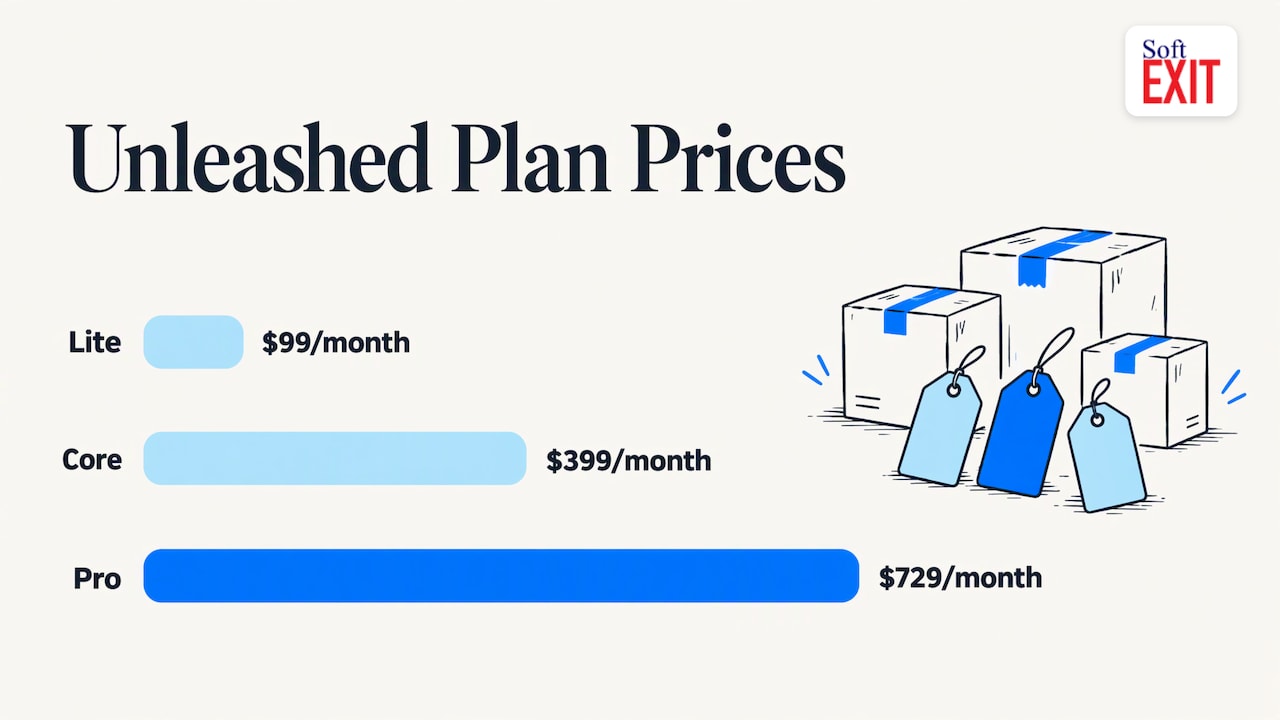
Unleashed’s US site describes unified buying, warehousing, sales and production, with multi-location inventory, demand forecasting, BOMs and batch and serial traceability. Its pricing page lists Lite at $99/month, Core at $399/month and Pro at $729/month at normal rates, with promotional pricing shown for Core and Pro. Order-capacity upgrades run from $70/month for up to 500 orders to $490/month for unlimited. Advanced Inventory Manager and Warehouse Management are each $149/month, free with Pro.
For a deeper side-by-side, see our guide to Unleashed alternatives.
Ordoro: shipping and e-commerce operations
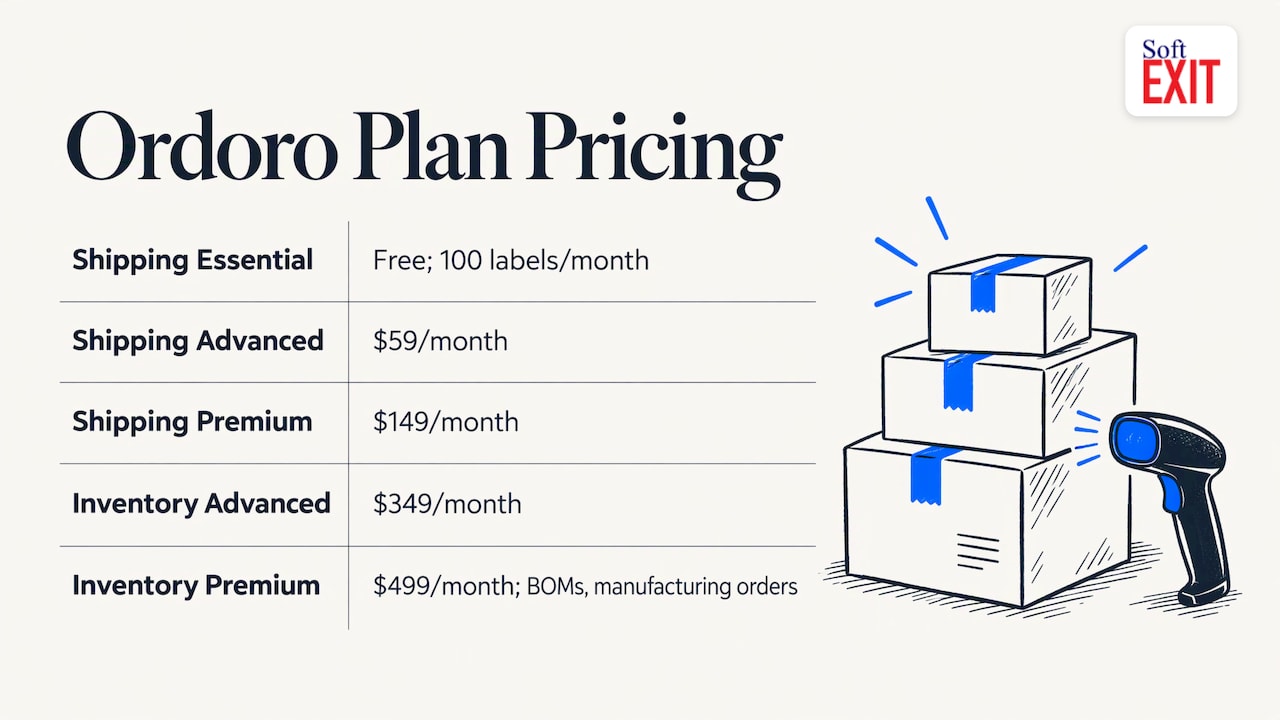
Ordoro positions itself as an operations platform combining shipping, inventory, purchase orders, kitting and dropshipping, connecting to Shopify, BigCommerce, WooCommerce, Amazon, Walmart, eBay and Etsy. Its pricing page lists Shipping Essential as free with 100 monthly labels, Advanced at $59/month and Premium at $149/month. The inventory tiers are $349/month for Advanced and $499/month for Premium, and only Premium adds bills of materials and manufacturing orders.
If your bottleneck is fulfillment rather than production, this is worth a look. A case study on ecommerce operations automation shows what automating that layer can involve.
MRPeasy, Fishbowl, Odoo and the rest
SpotSaaS lists these as commonly compared:
- MRPeasy: cloud MRP with capacity planning and routings. One review site frames the choice as stock syncing, where Katana wins, versus shop-floor scheduling, where MRPeasy wins.
- Fishbowl: inventory and manufacturing with deep QuickBooks integration. Our Fishbowl alternatives guide covers the no-code route.
- Cin7 Core: inventory, a B2B portal and light manufacturing.
- Odoo MRP: a modular ERP with manufacturing, accounting and e-commerce apps. Results depend on the implementation partner. Flectic notes that adding manufacturing, accounting or inventory modules triggers per-user pricing.
- Stocksmith (formerly Craftybase): for handmade and small-batch producers, with plans from $41/month billed annually.
If you migrate to any of them, check the costing method before go-live so opening valuations match, as TechUltra advises.
How to choose
- Write down what Katana fails to do. Cost, reporting depth, locations, accounting or CRM. Each points to a different alternative.
- Count the tools you pay for. If inventory, customers, contracts and reports sit in four subscriptions plus spreadsheets, one platform changes the math.
- Price at your real volume. Ask each vendor for a quote at your order count, locations and users.
- Check permissions and data control. Role-based security and protected fields matter when several teams share one database.
- Run a pilot. Move one process first, such as stock tracking or the sales pipeline, before migrating everything.
Our perspective
Most businesses that outgrow a specialist tool do not need a bigger specialist tool. They need their data in one place and the freedom to shape it around how they actually work.
That is why we built SoftEXIT Studio as a platform instead of a single app. CRM, contracts and the apps you build yourself share one database, one security model and one membership starting at $5/user/month, billed annually. You are not paying a new subscription each time a department asks for a tool.
With AI Architect on Professional, you describe the process in plain language and Studio configures it on a proven framework. We think that is the faster, easier-to-maintain path for teams replacing spreadsheets.
James Edgell
Try SoftEXIT Studio
If you want to replace spreadsheets and per-app subscriptions with one customizable platform, start with SoftEXIT Studio. Every membership includes the available business apps, and you can build your own forms, dashboards, reports and databases without code.
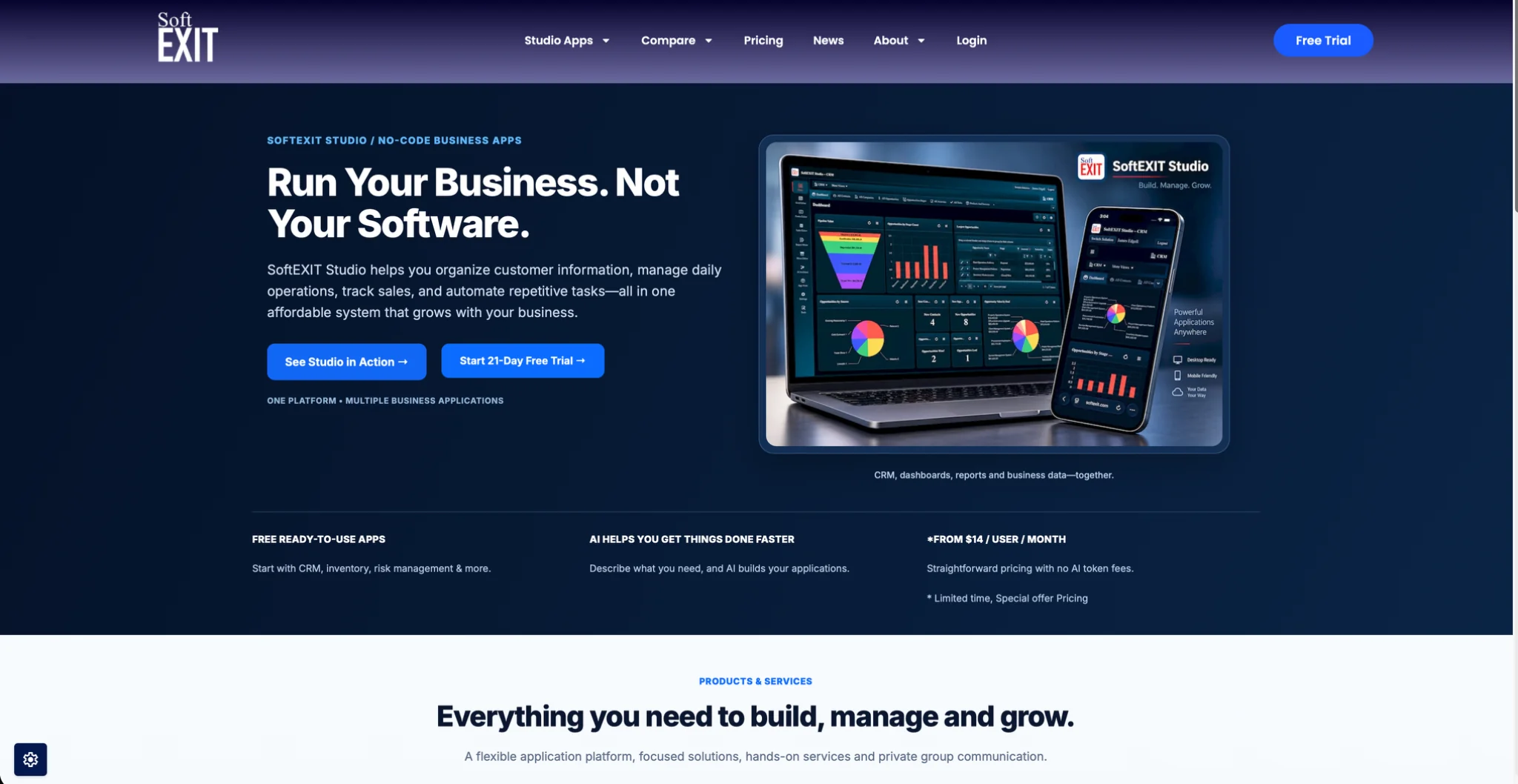
Starter is $5 per user/month billed annually, Professional is $9 per user/month, and there is a 21-day free trial. Start your free trial, or see how Studio compares with Quickbase.
FAQ
What is Katana MRP?
Katana is a cloud MRP system for small and midsize product businesses. It handles inventory, orders, purchasing, production and warehousing, and connects to e-commerce, accounting and shipping tools.
What is the cheapest Katana alternative?
SoftEXIT Studio starts at $5 per user/month, billed annually, with apps included. Ordoro offers a free shipping tier with 100 monthly labels, and Unleashed Lite is $99/month.
Can I build an inventory system without code?
Yes. In SoftEXIT Studio you can create relational databases, forms, dashboards and reports, then set role-based permissions. Professional’s AI Architect can configure an app from a plain-language description.
When should I stay on Katana?
If your products are simple, your volume is modest and the current setup works, switching may add cost without benefit. Move when pricing, scope or reporting limits clearly hold you back.
Sources
- SoftwareConnect: Katana MRP review
- Brahmin Solutions: Katana MRP alternative
- InventoryQuick: Katana pricing explained
- TechUltra Solutions: Odoo vs Katana
- Unleashed US site
- Unleashed US pricing
- Ordoro homepage
- Ordoro pricing
- SpotSaaS: Katana alternatives
- Listicler: MRPeasy vs Katana
- Flectic: Odoo vs Katana
- Tarostack: Katana MRP alternatives
- CoreWorx: ecommerce operations automation