Citizen Development Governance: A Buyer’s Guide for 2026

Citizen development governance is the set of rules, roles and platform controls that let business users build their own applications without exposing data or creating unsupported “shadow IT.” For a small or midsize business, the simplest way to get it right is to choose a no-code platform where permissions, shared data and approved building blocks are built in, so governance is a setting and not a separate project. SoftEXIT Studio includes its business apps with a membership starting at $5 per user/month, billed annually.
Key Takeaways
- Governance is what separates a useful departmental app from shadow IT: defined owners, access rules, review before launch and a plan for retirement.
- Research on citizen development finds that governance must fit the actual platform, because permissions, versioning and project features differ between tools.
- Scale the review to the risk: an app with external users or sensitive data needs more checking than a team tracker.
- One platform with role-based security and shared apps is easier to govern than a dozen spreadsheets and point tools.
- SoftEXIT Studio Starter costs $5 per user/month and Professional costs $9 per user/month, both billed annually.
What citizen development governance means
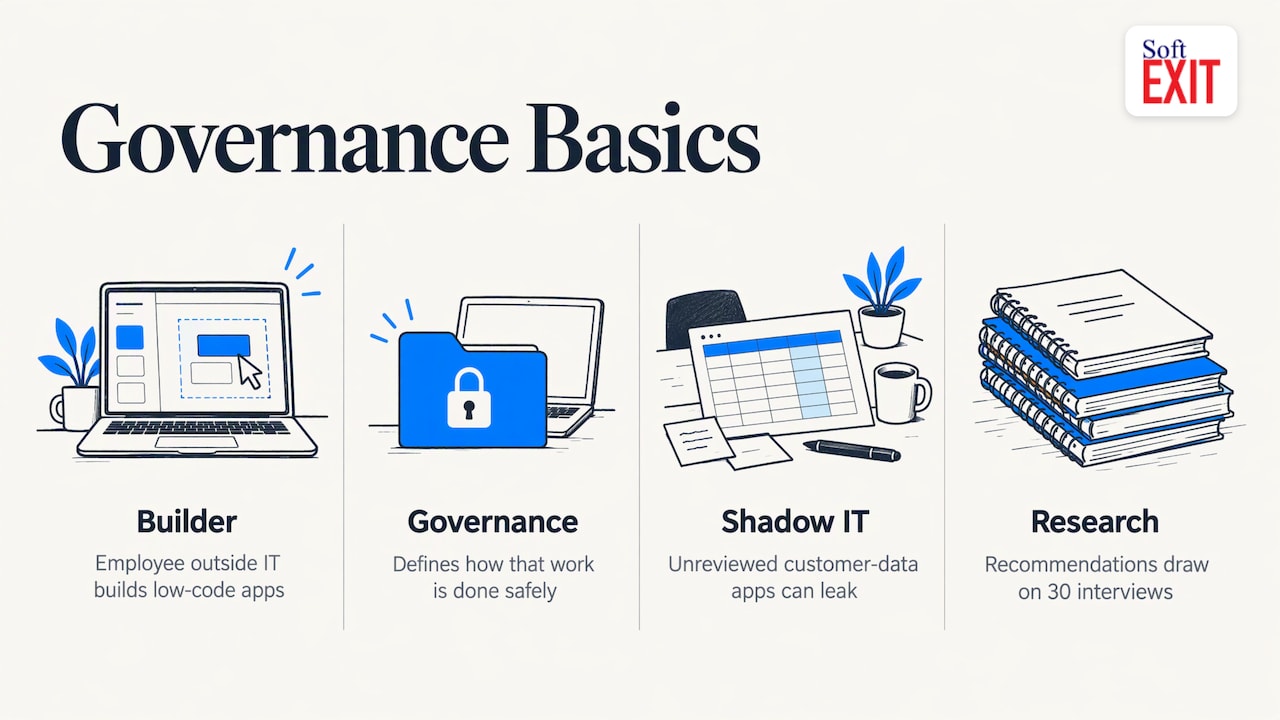
A citizen developer is an employee outside IT who builds an application with a no-code or low-code tool. Governance defines how that work is done safely. An academic study of the topic notes that it differs from conventional software-development governance and addresses the shadow-IT risks of departmental applications created independently. Its recommendations draw on 30 interviews with citizen developers and low-code experts.
Shadow IT is the problem governance solves. A sales manager’s private spreadsheet of contacts, or an unreviewed app that holds customer data, works until someone leaves, the data leaks or two teams build the same thing twice.
Why governance matters for business-built apps
CGI, a technology consultancy serving U.S. federal clients, lists the risks as exposure of personally identifiable information, malicious intrusions, unsafe testing and configuration management, incompatibility, duplicated work, compliance and cost. The OWASP community’s low-code risk list adds account impersonation, authorization misuse, data leakage and logging failures.
The goal is not to slow people down. Gartner’s research frames the aim as enabling citizen developers to produce high-quality applications quickly and securely, with support from engineering leaders.
The core elements of a governance framework
You do not need a federal-sized program. You need these five elements, scaled to your company.
1. Roles and decision rights
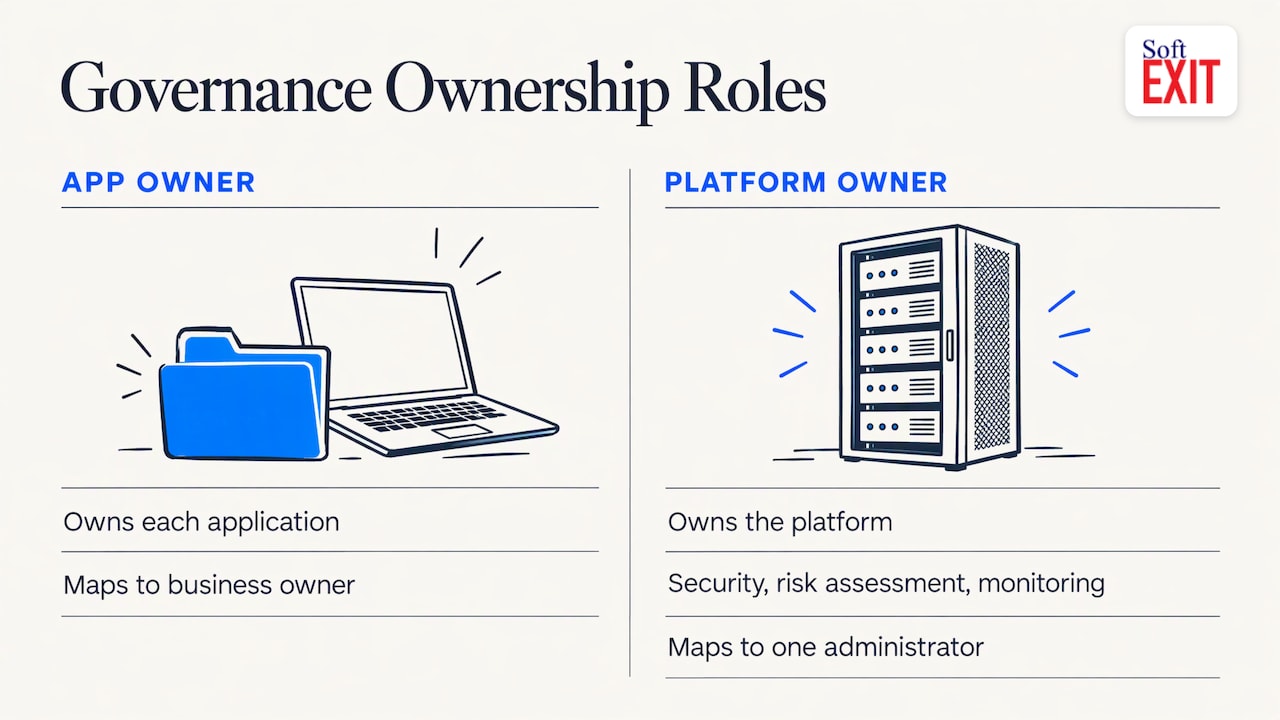
Name an owner for every application and an owner for the platform. The U.S. Army’s low-code/no-code guidance separates application sponsors and owners from platform owners, who handle platform security, risk assessment and continuous monitoring. A small business can map this to two people: a business owner per app and one administrator for the platform. FTI Consulting suggests a cross-functional steering committee to assign accountability for security, maintenance and incident response.
2. Access and data controls
Who can see which record, and which fields? The same Army guidance has application owners manage data access and expects enterprise identity and access services. For you, that means role-based permissions, protected fields for sensitive data and no shared logins.
3. Risk-based review
FTI recommends scaling testing and controls to user population, external exposure and data sensitivity. TDIndustries, a U.S. contractor, describes a pre-deployment review of security, data storage and authentication, then a product approval for strategic fit and duplication. A one-page checklist covers most small-company needs.
4. Change management
The academic study flags harmful changes in live production environments as a real risk. Separate building from using, and review significant changes before they go live.
5. Training and retirement
OWASP’s Citizen Development Top 10 frames its advice around collaboration between business, security and governance functions. Train builders on the platform and on data handling, and decide in advance who retires an app that is no longer used.
Why the platform choice is half of governance
The study’s central point is that governance must be tailored to the actual platform, since permissions, versioning and project features vary. Public-sector rules reflect this: Nebraska’s standard 8-608 requires cloud low-code/no-code projects to be reviewed and approved and to use vendor-supported software.
When you evaluate a platform, ask these questions:
| Governance need | What to look for |
|---|---|
| Access control | Role-based security down to the field level |
| Duplication | Shared apps and data on one platform |
| Reporting | Dashboards and reports on live data |
| Reuse | Reusable components so builders start from approved parts |
| AI use | Existing permissions applied to any AI connection |
SoftEXIT Studio supports each of these. It offers role-based access control without code, down to protected fields, reusable application components, hierarchical data, dashboards and reports. Its AI Agent integration uses the Model Context Protocol (MCP), an open standard for connecting AI assistants to business tools, and applies Studio’s existing security controls and user permissions.
If you are weighing it against a larger suite, the SoftEXIT Studio and Microsoft Power Apps comparison sets the two side by side. Other platforms in this space include Airtable, Quickbase, Knack and Salesforce, and each prices applications differently.
What a governed rollout looks like
- Start with one pilot. Pick a spreadsheet-driven process such as a sales pipeline or contract list.
- Name the owners. One business owner, one platform administrator.
- Set roles before data goes in. Decide who views, edits and approves.
- Review before launch. Check access, data sensitivity and duplication.
- Monitor and retire. Review usage each quarter and archive unused apps.
The guidance from Gartner on defining decision rights and applying risk-based guardrails supports this approach: protect the business and keep delivery light.
Perspective
Most governance programs fail because they are written as a list of prohibitions. We think governance works when the safe path is also the easiest path.
That is why we put CRM, Contract Management and other business applications on one platform, under one membership, with shared role-based security. Teams do not need to buy and secure a separate tool for each need, and administrators see one environment instead of many.
With SoftEXIT Studio, organizations can customize applications, build databases, forms, dashboards and reports without code. On Professional, AI Architect turns plain-language requirements into application configurations built on Studio’s established framework, rather than generating custom code that someone has to maintain.
Governance should mature useful team solutions into supported company applications. A platform that makes that natural is worth more than a policy document.
James Edgell
Start with one governed application
SoftEXIT Studio gives you business apps under a single membership. Starter costs $5 per user/month, billed annually, and Professional, which adds AI Architect, costs $9 per user/month, billed annually. Optional Agent subscriptions for AI connectivity are listed at $19, $50 and $99 per month.
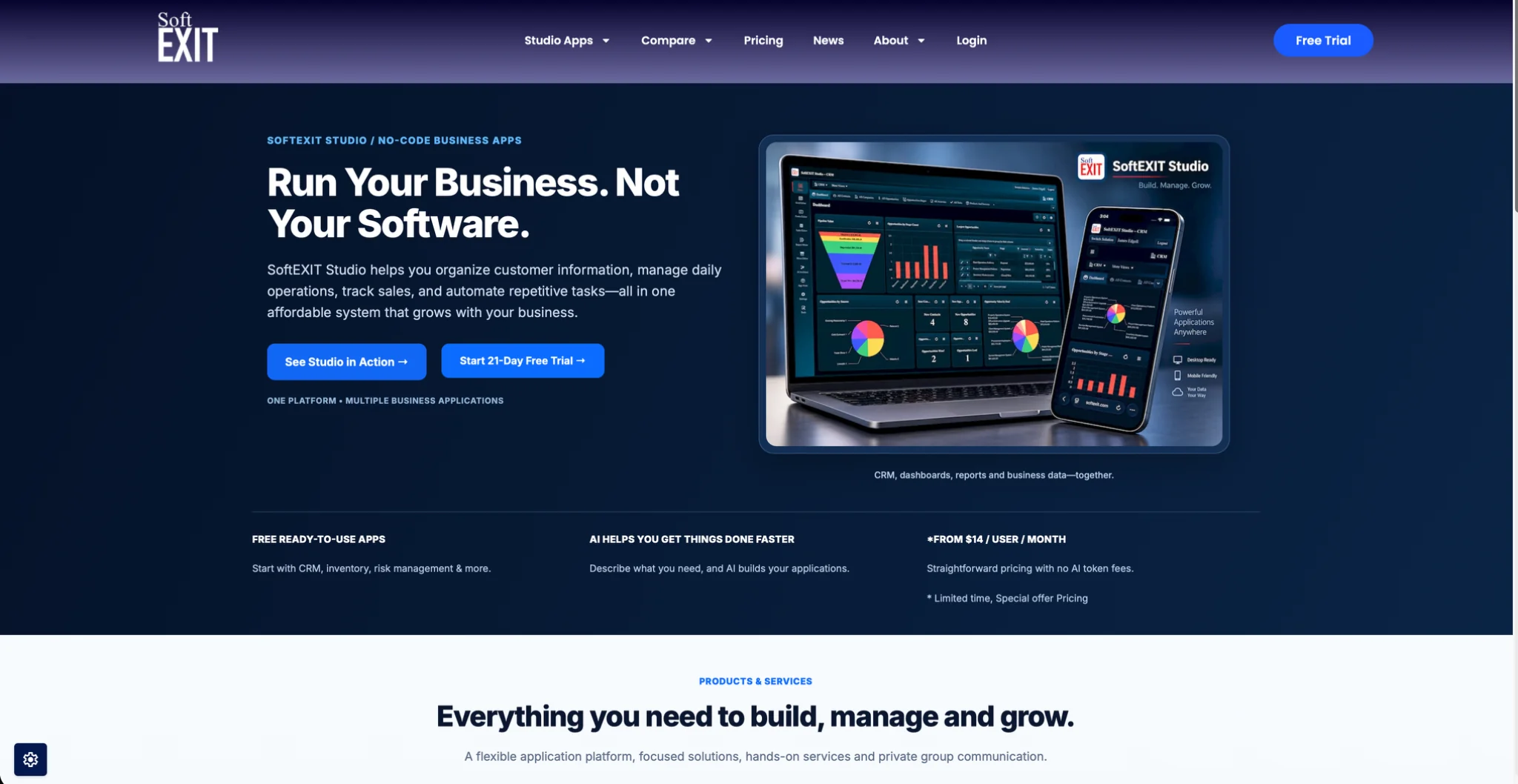
There is a 21-day free trial. See SoftEXIT Studio plans, or start with the SoftEXIT CRM to replace a pipeline spreadsheet first.
FAQ
What is citizen development governance?
It is the policies, roles and platform controls that guide how non-IT employees build applications. It keeps access, data and quality under control while letting business teams move quickly.
How is it different from shadow IT?
Shadow IT is software built or bought without oversight. Governance brings those same departmental apps into view, with owners, access rules and review, so they can grow into supported company tools.
Do small businesses need a formal governance program?
They need the same elements at a smaller scale: an owner per app, role-based access, a short pre-launch review and a retirement plan. Choosing a platform with built-in permissions covers much of it.
How does AI change governance?
Any AI assistant connected to business data should work within existing permissions. In SoftEXIT Studio, AI Agent integration through MCP uses the existing security controls and user permissions, and allows authorized record operations.
Sources
- Governing Citizen Development to Address Low-Code Platform Challenges
- CGI: Bringing shadow IT into the light
- OWASP: Security for Citizen Developers
- Gartner: How to Support and Govern Low-Code Applications
- Gartner: Govern Citizen Development Without Slowing Teams Down
- Army Low-Code/No-Code Development Guidance
- FTI Consulting: How CIOs Can Govern the Rise of Citizen-Built Apps
- TDIndustries Citizen Developer Program
- OWASP Citizen Development Top 10
- Nebraska Information Technology Commission Standard 8-608