Airtable in 2026: What It Is, What It Costs, Where It Fits

Airtable is a cloud platform that mixes a spreadsheet’s friendly grid with a relational database’s linked tables, so non-developers can build trackers, simple apps and automations. It works well for project tracking, content calendars and small to mid-sized datasets. It gets shaky when it becomes the system of record for a big operation. And it is now owned by a new company, which matters if you plan to build on it for years.
This guide covers what Airtable does well, where teams hit walls, what changed this year, and how to decide.
Key takeaways
- Airtable is a spreadsheet-database hybrid with views, forms, automations and AI features. It is easy to start and popular for good reasons.
- Experts flag performance and data integrity risks when it serves as a production backend for large apps, especially near 100,000 records.
- Bending Spoons bought Airtable this year and has since cut a large part of the pre-acquisition staff. Vendor risk is now a real line item.
- Per-seat pricing adds up fast. Do the math for every editor before you commit.
- If CRM or operations are the real job, a purpose-built no-code platform can be the safer long-term home.
What Airtable actually is
The Zapier beginner guide describes Airtable as a cloud-based platform for creating and sharing relational databases that doesn’t require programming. That’s the fair summary. You get a table that looks like a spreadsheet, but each column has a real type (dates, checkboxes, attachments, linked records), and you can look at the same data as a grid, a kanban board, a calendar or a form.
The company is headquartered in San Francisco, and Wikipedia lists spreadsheet, database and AI agent services among its products. Airtable says on its homepage that more than 500,000 brands use it. Reviewers agree it’s popular: TrustRadius shows a score of 8.5 out of 10 across 849 reviews.
What people use it for
The top question people ask is “what is Airtable used for?” Common answers:
- Project and task tracking across teams
- Editorial and marketing calendars
- Light CRM, such as lists of leads and contacts
- Inventory and asset lists
- Event planning and intake forms
Is it just Excel? No. Excel is a calculation tool with a grid. Airtable’s strength is relationships between tables: one customer linked to many orders, one project linked to many tasks. That’s database thinking in a spreadsheet costume. If your pain is that spreadsheets keep breaking, our comparison of SoftEXIT Studio vs spreadsheets goes deeper on that jump.
Where Airtable starts to strain
Nobody outgrows Airtable on day one. It happens around month eighteen, when the base that began as a tidy tracker is now running the company.
Scale. The analysis in InformationWeek says Airtable is excellent for collaborative project management and small-to-medium datasets, but can suffer serious slowdowns and data integrity risk as a production backend for large applications, particularly as record counts approach 100,000.
Seats. Airtable bills by person, so a tool that began with five users and grows to fifty changes the budget conversation. Check the current plan page before you plan headcount.
Structure. A base is flexible, which also means anyone with edit rights can rename a field and break a dozen automations. Governance (who can see and change what) takes deliberate design, not luck.
Business apps. Airtable can imitate a CRM. A real CRM needs pipelines, activity history, tasks, service cases and role-based security from the start. Bolting those onto a general base is possible, but you’re the one maintaining it.
The 2026 shake-up: a new owner
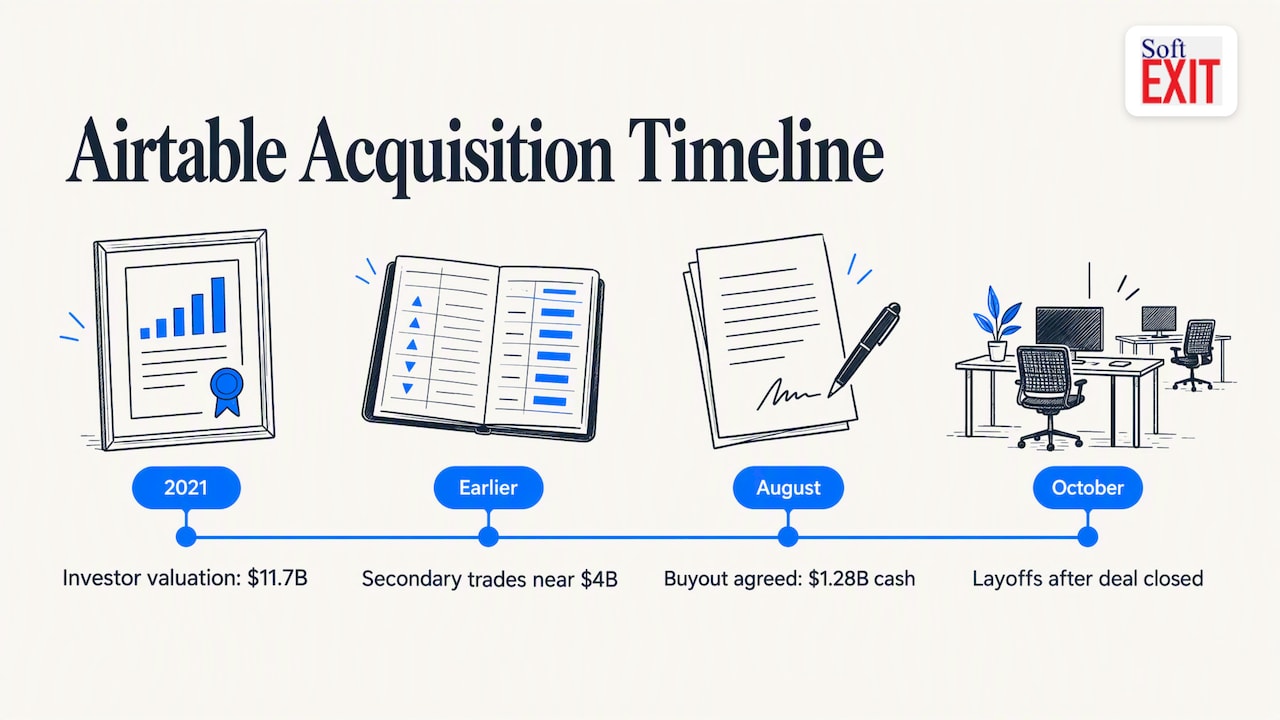
This is the news that moved “Airtable” searches this fall. In August, TechCrunch reported that Bending Spoons agreed to buy Airtable for $1.28 billion in cash. That’s a long way below the $11.7 billion valuation investors gave it in 2021, according to TechCrunch, which also noted secondary-market trades near $4 billion earlier in the year.
Then, in October, the San Francisco Chronicle reported Airtable is laying off a large portion of its pre-acquisition workforce, weeks after the deal closed. InformationWeek framed it as a vendor risk story, noting the new owner had promised to invest heavily in product and support just before the cuts.
We’re not predicting what happens next. Plenty of products do fine after an acquisition. But if Airtable holds your customer data, the sensible move is to ask a few boring questions now: Where would we export to? Who owns the automations? What breaks if pricing or support changes? Our own roundup of Airtable alternatives after the acquisition walks through that thinking.
A short story about the Tuesday base
A sales ops manager we’ll call Dana built a quick Airtable base to track twelve deals. It was lovely. Within a year, it held 40 tables, three interns’ worth of automations, and a field called “Status (NEW) (use this one)” sitting beside “Status (old)” and “Status FINAL v2.” When Dana went on vacation, nobody dared touch it. The one person who understood it, a part-timer named Greg, was always “about to document it.” Then Greg left. The base is still running. Nobody knows how. It’s basically the office ghost, and every Monday someone whispers, “just don’t edit anything.”
That’s the real cost of a tool that is too easy to start and too loose to govern.
How to decide: stay, expand or move
Use these criteria rather than gut feel.
| Question | Stay on Airtable | Consider moving |
|---|---|---|
| How big is the data? | Well under tens of thousands of records per base | Growing toward 100,000 or more |
| What’s the main job? | Project tracking, calendars, light lists | CRM, service, contracts, inventory, risk |
| Who edits? | A handful of trusted people | Many roles needing different access |
| Vendor tolerance | Fine with change | Needs predictable pricing and support |
| Compliance | Few rules | Needs field-level protection and audit trails |
If you’re mostly in the left column, keep going and just clean up your bases. If you’re in the right column, look at moving the critical workflow to something built for it. A good first step is our piece on three moves to build a no-code database you can trust, which applies wherever you end up.
Our perspective
We build on the same belief that made Airtable popular: business teams should be able to shape their own tools without waiting on a dev queue. Where we differ is on what happens next.
A flexible grid is a fine start. But once the work is customers, pipelines and contracts, teams want structure that was designed for it: hierarchical data, role-based security, protected fields, dashboards and workflows that sit together on one platform. That’s why SoftEXIT CRM is built on SoftEXIT Studio, a no-code platform where AI-driven configuration helps you create databases, forms, dashboards, reports and workflows. You begin with CRM. When inventory, risk or contract tracking comes up, you build it in the same place instead of stitching together another tool.
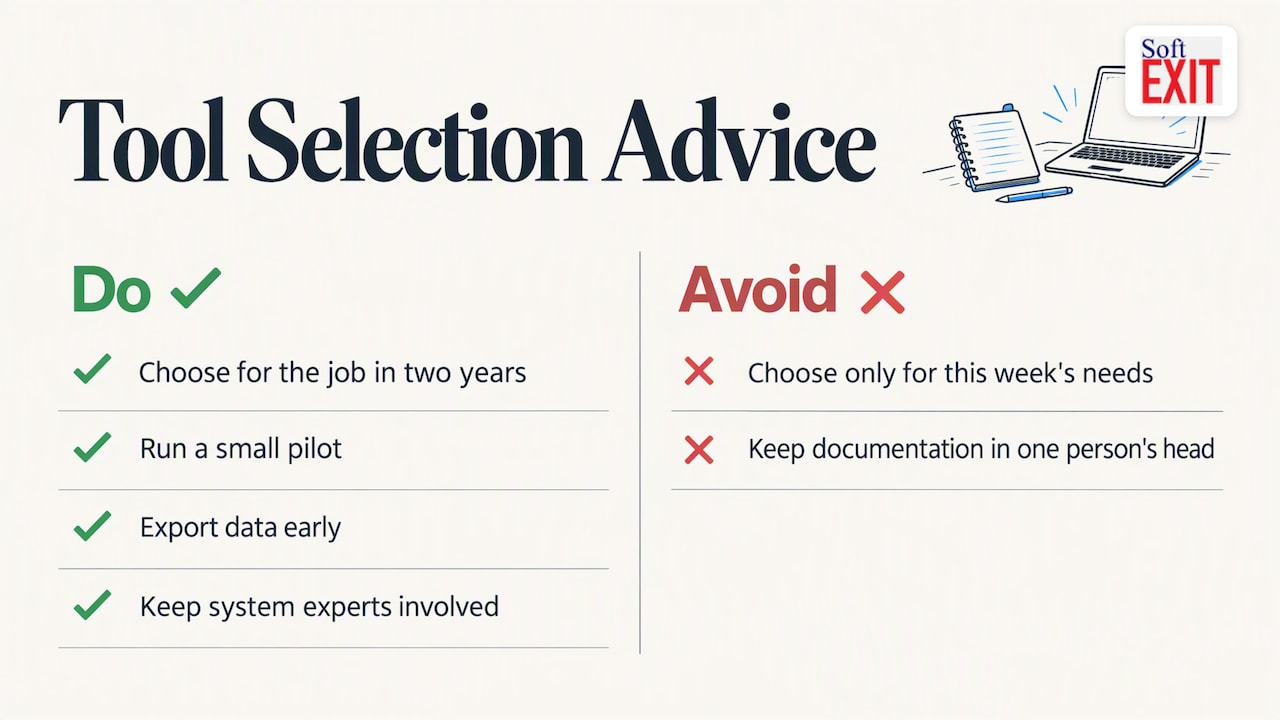
Our advice is simple: pick the tool for the job you’ll have in two years, not the one you have this week. Run a small pilot, export your data early, and keep the people who understand the system in the loop. Documentation that exists only in Greg’s head isn’t documentation.
— James Edgell
Trying SoftEXIT instead
If you’re weighing a move, SoftEXIT Studio is published at $14 per month per user on Starter and $24 per month per user on Professional, with Enterprise available through sales. You can start with SoftEXIT CRM for contacts, companies, opportunities, pipelines, activities and service, then grow into other apps. For a side-by-side look, read SoftEXIT Studio vs Airtable. If you’d rather not configure it alone, our professional services team can help with implementation.
FAQ
What is Airtable used for?
Teams use it to track projects, plan content, manage lists of leads or inventory, and collect information through forms. It’s a database with a spreadsheet’s feel, plus automations and AI features. It suits lightweight workflows best.
Is Airtable just Excel?
No. Excel focuses on calculation, while Airtable stores structured, linked records and shows them in several views. You can connect a customer to orders or a project to tasks without copying data around.
Why is Airtable struggling?
It isn’t clear that it is, but the signals are mixed. Its valuation fell sharply from its 2021 peak, it was sold for $1.28 billion, and the new owner is cutting a large share of staff. Customers should plan for change.
Is Airtable fully free?
It has a free tier, but paid plans are billed per seat and raise limits on records, automations and features. Check Airtable’s current plan page before you build anything you can’t afford to move.
Sources
- What is Airtable? (Zapier)
- Airtable (Wikipedia)
- Airtable reviews (TrustRadius)
- Bending Spoons to buy Airtable for $1.28B (TechCrunch)
- Airtable valuation and Superagent (TechCrunch)
- Airtable layoffs after sale (San Francisco Chronicle)
- Airtable’s post-acquisition layoffs put vendor risk in focus (InformationWeek)